Source: The national tribune, 18 October 1894.FELL INTO THE TRAP.
How the Fifteenth Corps Was Thrown Into Confusion at Cheraw.
Editor National Tribune: The Fifteenth Corps was advancing on the road toward Bentonville, N.C., going through the town of Cheraw, arriving at the Pedee River about 10 o'clock in the forenoon. The First Division was in advance, commanded by Gen. C.R. Woods. The First Brigade led the advance of the First Division, and consisted of the 27th Mo., 76th Ohio, 12th Ind., 26th Iowa, and 32d Mo.
On arriving at the Pedee River we found the bridge had been destroyed by the enemy, which necessitated its reconstruction before our command could cross. A halt and several hours' delay was the consequence. The division was drawn up en masse on the most available ground near the approach to the bridge, on a bluff overlooking the Pedee. The First Brigade occupied the ground near the cut in the bluff through which the road to the bridge led. This cut was about 25 feet deep. in our front was a bluff some 60 or 70 feet high, under which the river flowed, and on our left was a ravine, or a depression in the ground, leading to the river, and still further to our left and rear, across the ravine, was an old warehouse, in which the enemy stored fixed ammunition, shot and shell and gunpowder.
On our approach to Cheraw the enemy destroyed the bridge and distributed the shot and shell in the ravine, and scattered a large quantity of gunpowder broadcast amongst it. They knew we would have a halt to build the bridge and that we would occupy the ground with our train, it being the most available, and hence laid the trap for us.
When our command stacked arms the men set about cooking coffee, and in hunting up material for fuel made the discovery of the fixed ammunition in the ravine, and also that ti had been stored in the old warehouse, the floor of which was nearly covered over with loose gunpowder and a train laid to the ravine, and in the warehouse yet remained a quantity of shell and gunpowder. Q.M. Serg't Marvin Trott, of the 27th Mo., first called my attention to it.
The trap was not over 75 feet from where my company was. I went with Trott, and found the arrangement for our destruction as here stated. Several of the men of our brigade were passing to and from the warehouse across the ravine, hunting fuel to build fires, and I cautioned my company the danger we were in.
It was not over 10 minutes after I returned to my company that the explosion occurred. Somebody dropped fire in it, probably from his pipe. The shells commenced exploding very fast, something after the fashion of a barrel of firecrackers set off. I hallowed to my company to drop flat on the ground.
The supply train was drawn up en masse close in our rear, facing the ground the men occupied, the teamsters not in their saddles, but preparing some coffee. The mules took fright, and a general stampede of teams commenced. The direction in which the animals went was directly over the ground occupied by the First Brigade and right on to the men, the most of whom dropped on the ground.
A grand scramble for dear life now ensued. Between running wild teams and exploding shell the danger was fearful.
Those first to their feet ran before the teams, while many were run over or caught amongst the mules and wagons. Some of the teams tore loose from the wagons by running into one another. The men in hundreds jumped and tumbled down the cut leading to the bridge to the road below, the most of them falling in the scramble and rush down, and many of the teams came dashing down on top of them before they were able to regain their feet. Gen. J.A. Logan and Gen. C.R. Woods and Gen. William B. Woods were down at where the bridge was building at the time of the explosion. I think there were more shells exploded in 10 minutes here than was exploded by the artillery of both armies on the memorable 13th of May at Resaca, or was exploded a few weeks later at the artillery duel at Kenesaw Mountain.
This was the first time I ever saw any of the First Brigade run for safety, and the only stampede I ever saw in the Fifteenth Corps.
– Jas. O'Conner, First Lieutenant, 27th Mo.
Thursday, May 12, 2011
"Fell Into the Trap."
Twenty-nine graying years after the event, First Lieutenant James O'Conner of Company F, 27th Missouri returned to his memories to share a particularly exciting event during the 1865 Carolina campaigns. The incident is particularly palpable now due to its Improvised-Explosive-Device related nature -- proof that unconventional warfare can be a truly American tactical concept as well.

Wednesday, May 11, 2011
"I can knock the chimney off."
On August 20, 1885, Orderly Sergeant John W. Bannan of Company A, 4th Iowa wrote to the editor of the National Tribune from his home on the plains of Chetopa, Kansas. His hopes lay in dispelling some of the rumors and confusion concerning the Fifteenth Corps' role in the controversial capture of Columbia, South Carolina and argued that while other comrades had nothing but fading memories as ammunition in debate, he had meticulously maintained a diary during the campaign which he uses to relate his experiences here in substantial detail.
Source: The national tribune, 20 August 1885
COLUMBIA, S.C.A Member of the 4th Iowa Consults His Diary.
To The Editor: I have always taken great interest in the historical communications of old comrades, whether they wore the pumpkin rinds, the chevron, or simply stood a high private in the rear rank. All tell more or less truth, and all make more or less mistakes; – caused, no doubt, by relying entirely, or at least to a great extent, on memory. Old comrades, memory of 20 years back is very treacherous. I would not write now if I relied on my memory, as I have set out to write, about Columbia, S.C.,; but I, fortunately for myself if not others, kept a journal of my more than four years' army life. On the 15th of February, 1865 we camped within 10 miles of Columbia, and on the 16th marched before the men had breakfast. It had rained all night, but we had a good meal prepared and nearly cooked in the morning – chicken stewed with sweet potatoes and fried fresh pork and corn cakes, also coffee. But when the drum sounded the “fall in” I rolled up my wet dog tent, took some chicken and pork in my haversack, coffee in my cup, and called Co. A to “fall in.” If there had been nothing unusual we would have finished breakfast, but already the Second Brigade, First Division, Fifteenth Corps, was skirmishing with the Johnnies, and as the Third Brigade came next in line of march, and the 4th Iowa in advance of the brigade, we could not delay a moment for breakfast. The Second Brigade drove the enemy back about four miles to Congeree Creek, where, just across the bridge, a strong fort was built and tow fieldpieces mounted. The Second Brigade could not drive them from this strong position. After a couple of hours' skirmishing and artillery firing, the Third Brigade moved to the left, and each man in the 4th Iowa took a rail on his shoulder, carried them about 40 rods, and bridged a small stream. After going about half a mile we formed in line of battle, and the other four regiments of the Third Brigade – the 9th, 25th, 30th and 31st Iowa – formed line about 50 yards in rear of us. The 4th Iowa deployed and advanced as skirmishers, the other regiments of the brigade following in supporting distance. We passed around one small swamp, but soon came to another, which proved to be about 300 yards wide and passing our flanks, and from knee to waist-deep. Through this swamp we went, and as we came out on the other side the enemy retired in front; made a right half-wheel and moved toward the fort, drove the skirmishers of the enemy across the creek, and were soon on the south bank of the creek within 75 yards of the enemy's works. An hour and a half was consumed in effecting the crossing of the creek. As soon as we gained a foothold the enemy retired, and we were in the fort before he was out of musket range.
Gen. Billy Sherman was in with us soon, and remarked that we looked as if we had been bathing, and by his appearance we thought a bath would not hurt him, as he was covered with mud. We moved forward about a mile, and camped, or stacked arms as if in camp. The rest of the brigade joined us here, and we camped for the night.
On the 16th of February the Second Division of the Fifteenth Corps moved forward and drove the rebels across the Congeree River, below Columbia, where they had a battery on the east bank of the river.
About noon the First Division, Fifteenth Corps, moved forward and formed in line of battle in front of Columbia, with nothing but the river intervening. De Grasse's battery of Parrotts took position about 20 steps in front of us and shelled the town. I was amused to see the gunners knock the chimneys off the buildings. While watching, several officers assembled in a group, Sherman among them, and a request was made to throw a few shots at the arsenal, over a mile away on the left front. De Grasse handed his fieldglass to a Sergeant, asked him to observe the building designated as the arsenal. The Sergeant said: “I can knock the chimney off.” There being several a chimney was designated, the Sergeant trained his pet, fired, and in due time the chimney flew.
About 4 p.m. we moved up the river about three miles, where the bridge was, but saw only the piers. However, a pontoon was already laid, and we crossed over the Saluda River and move don, as we thought to camp for the night; but the Third Brigade moved on with the pontoon train to the Broad River, and received orders to not light any fires, and be ready to cross the river as soon as ordered. We lay there, and, it being quite cold, was anything but comfortable. Towards midnight a picket was sent across and erected breastworks. The 31st Iowa crossed as fast as the three pontoon boats could carry them, the 30th Iowa, then the 9th and then the 25th. Day was now breaking and the 4th Iowa followed and by 8 a.m. of the 17th of February Col. Stone's Iowa Brigade was on the Columbia side of the Saluda and Broad River, which join just above Columbia and form the Congeree River. The 31st Iowa, a part of the 30th, and the picket began skirmishing as soon as light enough, and our lines were gradually moved forward as fast as boatload after boatload landed, and by the time the 4th Iowa was across the enemy was driven away. The 30th Iowa took 30 prisoners. We crossed in three pontoon boats, about 15 men in a boat. The brigade numbered about 2,000 men. We had just moved through the timber a distance of about a half mile, re-formed our line of battle, and halted about five minutes, when a carriage was discovered by the skirmishers approaching from the direction of the city with a white flag floating form tis top. The carriage contained the Mayor and two other citizens of Columbia, who surrendered the city to Col. G.A. Stone, of the 25th Iowa, commanding brigade. The Colonel commanding entered the carriage and with the flag of the 31st waving from the carriage top rode into the city the 31st following, and the res tof the brigade in column of fours, the 7th being in the rear of the line. Soon the 31st flag was waving proudly from the new State House. The 13th Iowa of the Seventeenth Corps claim the honor of being the firs tin the city. A few stragglers, perhaps, were in first, and they took a flag with them, which they lost, as they supposed by the fire, but since have had it sent to them.
– John W. Bannan, Orderly Sergeant, Co. A, 4th Iowa, Chetopa, Kansas.
Tuesday, May 10, 2011
"...our corps piled them up in heaps."
From two miles southwest of the "Hell Hole" at Dallas, Georgia on May 29th of 1864, Captain Speer left yet another record of his Company B, 31st Iowa's actions during the campaign; this time of its involvement in the "First Epoch" of the operations against Atlanta.
Source: Cedar Falls Gazette, 10 June 1864FROM THE THRITY-FIRST IOWA,Casualties in Company B.
Correspondence of the Gazette,Two Miles S.W. of Dallas, Georgia, May 29th, 1864.
Editors of Gazette: – I wrote a short letter for the Gazette yesterday but am afraid you will not receive it and will now write again. We marched from Woodville, Ala., on the 1st day of May, and arrived at Snake Creek Gap, three miles above Resaca, on May 9th, where we build rifle pits to protect the mouth of the Gap. On the 13th we gave battle to the enemy at Resaca. During the afternoon Sergt. Nelson N. Blakeslee was mortally wounded and H.T. Cooper received a severe flesh wound in the right arm, and James W. Burke a severe wound in the left foot. We left John Tyrrell at Snake Gap, sick with congestion of the lungs, and were notified on the 18th that he died on the 12th, after being sick only three days. On the morning of the 18th James Morrison was unwell and we also left him at Snake Gap. – I have since learned that he died in four or five days afterwards of hiccoughs. At Chattanooga J.O. Mills and W.M. Prouty were unable to march farther and were left to guard baggage which the boys of Company B could not carry on the march. During the 14th and 15th we were under fire near Resaca but sustained no further loss. On the night of the 15th the rebels retreated from Resaca. On the 26th Geo. Bawn died of sunstroke or congestion of the lungs, after being sick only forty-eight hours. On the same day we skirmished with the enemy without loss and took possession of the town of Dallas. Same evening we took position in front of the enemy, and about one mile south of Dallas. At dawn of day on the 26th Co. B relieved our pickets for the purpose of skirmishing with the enemy. In less than fifteen minutes afterwards Frederick Jacob was severely wounded in lower jaw and neck by a musket ball. Immediately afterwards an entire rebel regiment came over a ridge and drove in the skirmishers on our left. It then changed direction and marched on our left flank, the boys all discharged their pieces into their ranks at short-range as fast as they could load them. When the rebels came within 100 to 125 yards from us John Clough was dangerously wounded through both jaws and tongue by a musket ball. We were then obliged ot fall back on our regiment, and in doing so Harlow Perry, James Watson, and John Rarick were taken prisoners. As underbrush was thick on the ground I cannot say whether they were wounded or not. In about an hour after our skirmish line was driven in John Parmenter received a slight but painful wound in the neck by a musket ball. At 10 o'clock A.M. we were relieved by other troops, and acted as a reserve until 4 o'clock P.M. of the 28th, when the rebels were discovered advancing to charge the 2d Division of the 15th Corps. We immediately moved on double quick for about a mile and a half to support the 2d Division. – When we took our position every man in our regiment was found in his proper place although all were greatly heated and almost out of breath. By the time we arrived the rebels had commenced the assault and in a few minutes Hardee's Corps and one Division of Polk's Corps had assaulted the entire line of the 15th Corps. They advanced with from two to four lines of their best troops. parts of our line they charged twice and other parts three times, and each time our corps piled them in heaps. During the fight bullets, shells, canister, and grape flew around us thick and fast, but fortunately, this time none of Co. B were hurt. The loss of our Corps on this occasion was trifling. I think we did not lose more than 800 in killed and wounded and no prisoners. General Logan says he feels confident the enemy's loss was not less than 3,000. This time we had the advantage of them. They met us at our own rifle pits. The 4th and 31st Regiments Iowa Volunteers are now on the extreme right of the 15th Army Corps. Last night we worked hard on rifle pits and have now a strong position. Last night about 9 o'clock the enemy assaulted Hooker on our left and were repulsed with heavy loss. I cannot say positively, but from all I can learn, I judge we have Johnson's army nearly surrounded. Many officers who rank high are of the opinion that he has not more than 60,000 troops. I believe we have 120,000 men. They still manifest great stubbornness but their stubbornness only makes the campaign interesting for such men as Sherman and Logan. – In battle we never saw a man appear so well as Logan. Yesterday he was half Peacock and half Tiger. All the boys of Co. B, present, except Windsor Clayton are well, and he is not seriously ill. The ranks of our Company have been greatly thinned within the last seventeen days; and each of the surviving members of the Co. tenders to the relatives of our fallen comrades a soldier's sympathy.
During the present campaign we will not be able to mail letters regularly.
[Note. – it is more than probable that the Captain is incorrect when he states that James Morrison is dead. Mr. Arthur Morrison of this place, the father of James Morrison [said] he received a letter form him the same evening that we received the Captain's, and that his son wrote that though he had been very near death's door, he was then recovering and considered out of danger. We most sincerely hope that this be true. – Eds. Gaz.]
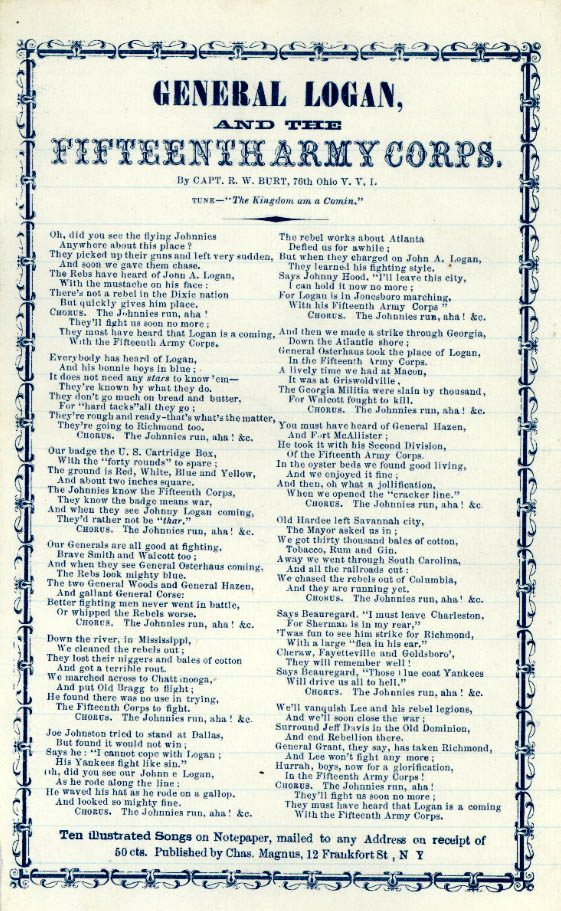
Monday, May 9, 2011
"...so great a slaughter."
On July 31, 1864, three days after his Company B of the 31st Iowa had mercilessly shot down yipping Rebels charging their rapidly constructed log breastworks at Ezra Church, Captain Robert P. Speer wrote home to the Cedar Falls Gazette in order to fill in both those who could not and those who would not join him on the front in regards to the 15th Corps' actions during what would be known as the 'Third Epoch' of the Atlanta Campaign. The latter part of his letter goes far towards offering a glimpse into the political mindset of soldiers who have experienced such repetitive brutality over the course of several months.
[Note: While Speer's prose seems somewhat blocky, I have left it exactly as it was published, not wanting to insinuate where he might have proposed making a break in the paragraph. Also, some of the copy (largely many of the names) is badly damaged on the only surviving films of the paper, but I have done my best to transcribe the piece with as much accuracy as possible.]
[Note: While Speer's prose seems somewhat blocky, I have left it exactly as it was published, not wanting to insinuate where he might have proposed making a break in the paragraph. Also, some of the copy (largely many of the names) is badly damaged on the only surviving films of the paper, but I have done my best to transcribe the piece with as much accuracy as possible.]
Source: Cedar Falls Gazette, 12 August 1864
FROM SHERMAN'S ARMY,letter from Capt. Speer.Chattahoochee Railroad Bridge, Ga.July 31, 1864.
Messrs. Editors – On the 5th day of June the 15th Army Corps was withdrawn from the position which it held near Dallas and relieved the 20th Corps near New Hope Church where we remained until the 8th inst. – when we marched to Ackworth, a small village on the Chattanooga and Atlanta Railroad. At Ackworth we were joined by two Divisions of the 17th Corps under Frank P. Blair; and on the 9th we rested. Our moving towards the Railroad caused Johnston to fall back, and on the 10th inst. Sherman's entire army moved forward to a new position near Kenesaw Mountain, on which the enemy was again found in very strong works. At Ackworth I was obliged to go to the rear on account of sickness and remained in hospital until the 10th of July. I saw a procession at our field hospital on the 4th of July which I will not forget soon. Between three and four hundred sick and wounded soldiers crawled from their beds and marched round the hospital grounds preceded by a fifer and tenor drummer playing the tune entitled, 'Rally round the Flag Boys.” Their dress was uniform, to wit: Drawers, shirt and shoes. A large proportion of them were wounded. I noticed that many of them did not keep the step, but I think they were excusable as they had unfortunately lost legs and were obliged to march on crutches. Others again had arms amputated or in slings. Some had strips of cotton cloth wrapped round their heads, but it was not to keep the sun off.
The losses of Co. B, at Kenesaw Mountain, was Albert Heldt, killed, and Wm. H. Palmer slightly wounded in the knee. After 10 days skirmishing, several assaults and much the heaviest shelling on both sides which had been done during the campaign, Johnston fell back again to the Chattahoochee river – where he had built the strongest works we have ever seen. Between Kenesaw Mountain and the river Sherman took 4,000 prisoners. In a few hours our army had “dug itself under” again near the enemy's works; where constant skirmishing and shelling was kept up until the 9th day of July, when the 23rd and 4th Corps succeed in crossing the river about three miles above the Railroad bridge. On the 10th inst. the 16th corps marched back to Marietta, a pretty village on the railroad and about tow miles south of Kenesaw Mountain – thence to Boswell, a regular Yankee town on the Chattahoochee river and about eight miles above the pontoon on which the 4th and 23d corps crossed the river. Several years ago a very good covered bridge was built over the river at this place; which the rebels burned when our troops entered town. On the east side of Boswell is a fine stream, affording splendid water power. Very wealthy men from New York and Connecticut, built very large cotton mills, flouring mills, etc., on this stream some years ago. The flouring mills have been furnishing large quantities of corn meal, and the cotton mills 1,500 yard of cloth per day for Johnston's army. But here after they will furnish neither meal or cloth; as they “have all gone up the spout.” On [the copy is destroyed here] 16th to Boswell, and on the 12th the 17th corps followed the 15th. But little time was required to build a good temporary bridge on the piers and abutments of the old one. On the 13th inst. the 15th and 16th corps crossed the river and rested during the 14th. On the 15th day of July the entire army of the Tennessee marched to the railroad near Stone Mountain, which is about twelve miles east of Atlanta. After destroying several miles of railroad, it moved forward again and took possession of Decatur without much opposition. Three regiments (including the 31st Iowa Volunteers) were ordered to remain at Roswell and hold the bridge and also guard the train and beef cattle of the army of the Tennessee. On the 21st inst. five different couriers started from the front, with orders for us to fall back with the train and destroy the river bridge, as a heavy body of rebel cavalry was moving towards us for the purpose of capturing our train. But the couriers were captured and we received no orders to fall back until the night of the 24th. Early on the morning of the 26th inst. we crossed the river with our train and before night were safe in the rear of the 4th corps. The distance from Boswell to Marietta was ten miles and to our troops at the front was fifteen miles. Our train consisted of 2,000 six-mule teams and 1,500 head of beef cattle. – And as our entire guard consisted of only 1,200 effective men, I think I am safe in saying that all hands breathed easier when we halted with the train under cover of our army. On the 19th inst. the enemy attacked the 4th and 20th corps and the battle lasted for several hours. During the engagement the enemy lost in killed, wounded and prisoners, 6,000 men. Again on the 22d General Hood attempted to flank us on our left, which was held by the army of the Tennessee. in the operation he lost, in killed, wounded, and prisoners, 15,000 men. Our loss on the 22nd was about thirty eight hundred. The Iowa brigade of the 17th corps suffered most severely. During this battle we lost our brave and able department commander, (General McPherson). He was always cool – ever in the saddle, and his fall ensues general lamentation among the men of his army. General Howard now commands the army of the Tennessee. On the 22d General Walker who commanded General Polk's old corps, was killed. On the 27th General Hood began to mass his forces on our right. And on the same day the army of the Tennessee changed position, from our extreme left to our extreme right. During the afternoon of the 28th inst. the officers of our signal corps counted 27 rebel stands of colors moving towards us from the city on the double quick – while crowds of rebel ladies stood on the roofs of houses waving flags and handkerchiefs to cheer them on. They intended to flank us and were certain of success – but the 15th corps and John A. Logan were there. We had no time to build works but were posted on elevated ground near a fence, and our men had only time to throw a few rails in front of them, when the rebels charged in force. Our men, “lay low” and shot low. Poor devils! They were brave, but the air was too full of our lead; and after many fruitless attempts they fell back. They brought forward fresh men – reformed their lines and charged us again more desperately than before. Nearly all their shots were aimed a little too high. When there was no longer hope they crawled back out of range of our guns. Oh! What a fall was there my countrymen! In front of the 15th corps lay Seven Thousand Killed and Wounded 'Democrats.” (Modern democrats I mean). In no battle since the war commenced has there been so great a slaughter with such trifling loss to us. Our entire loss will not exceed eight hundred men. In the battles of the 19th, 22d, and 28th our entire loss will not exceed five thousand, and the enemy's loss will not be less than 28,000 men. it is safe to estimate the enemy's losses, in killed, wounded and prisoners between Dalton and Atlanta at forty-eight thousand men. Within the last ten days Hood received twelve or thirteen thousand reinforcements. Every day he receives squads of men from the swamps and mountains and little garrisons of Georgia, Alabama, and Mississippi. On the 27th inst., Generals Stoneman and Kilpatrick started for Macon with 13,500 picked men – mounted on picked horses. They have also taken with them three batteries of ten pounders. Sherman has sent Stoneman and Kilpatrick to Macon, to cook General hood's supplies, destroy railroads, etc. We hope they have time to visit our comrades, who are held by the Democratic party at Americus. Sherman could have taken Atlanta some time ago; but it would have done him no good. He is playing to catch Hood and destroy his army. Will he win? We all think so. The present campaign will not end until next Christmas. By that time Grant and Sherman will have killed and wounded one hundred thousand more of the men of Lee's and Hood's armies. Then I think we can have peace. About two-thirds of the women in Mississippi, Alabama, Georgia, Texas, South Carolina, and Virginia are now widows. And we pray that God may damn all Northern men who are mean enough to talk, think, or wink, compromise while Grant and Sherman are working on the husbands of the remaining third. I am aware of the fact that tens of thousands of orphan children in the Southern Confederacy go to bed every night hungry; “but the end is not yet.” Compromise or peace men of the North, you must be patient! your “fire in the rear policy” has prolonged the war. You have brought death, want, and suffering to us and our families. Your political maneuvering can't stop the work your friends commenced. The women and children of the South may wail! They may starve! If their friends and neighbors in the rebel armies can bear it we can. We can yet shed tears for our friends and we can also laugh at the calamities of our enemies. The President has issued a call for 500,000 more men. it suits us. But remember that we do not want volunteers who get their patriotism from the county treasury. Let us try a few conscripts. Rebels have made Union men fight and we believe that a little touch with the bayonet once in awhile will make copperheads fight also. On the 21st of July Sergeant Francis F. Pitkin, of Co. B, was taken prisoner by the enemy. We cannot say when we will be relieved from guarding the train of the army of the Tenn. Nearly all of the boys would rather be with our brigade. There is scarcely any sickness in Sherman's army. We have had excellent water all summer and very pleasant weather for this climate.
– R.P. Speer
Sunday, May 8, 2011
"Wants to Hear From Many."
On January 31, 1907, Private William Royal Oake of Company A, 26th Iowa wrote in earnest to the editor of The national tribune, in hopes of finding the boys of the 26th he had passed through the war beside. In the process, he left an interesting account of the volunteers from the Fifteenth Corps who manned the Tigress to "run the guns" at Vicksburg but failed in their attempt, washing ashore atop floating debris. Oake met these men in the Vicksburg Jail where he was himself at the time, having been captured while fighting in John Thayer's Third Brigade of Steele's First Division during the fighting.
Wants to Hear From Many.
Editor National Tribune: How is it I never see anything in The National Tribune from any of the old 26th Iowa boys? Are they all dead or are they still behind stumps and in the ditches, where so many of them were during the war, afraid to come out for fear of being shot? Come out of your holes, boys; the war is over, and you won't be shot! I would like to hear also from the boys of the 76th Ohio and 27th Mo., which for quite a while were brigaded with us. Especially would I like to hear from Serg't Sam Cooper, Co. A, 27th Mo., or from any of the boys who may know of him or who were in prison with him in 1863. I also would like very much to hear from the boys of, I think, the 57th Ohio, who volunteered to go as crew of the transport Tigress, which was trying to run the batteries at Vicksburg in the early part of 1863. She was sunk and the crew all taken prisoners and confined in the Vicksburg jail, where I was at that time. There were newspaper men on that ill-fated steamer when she sank. There were three of them on board, all representing New York papers, I think, who were captured and confined in the Vicksburg jail with the rest of us cattle. One of them was a man by the name of Richardson, who was afterwards shot in New York by a lawyer named McFarland. One of the others was the author of a book entitled “Four Years in Secession.” Well do I remember the morning these men were brought to jail. They looked like drowned rats. They had been floating on bales of hay which had been used as a protection to the steamer, and when she sank they took refuge upon them until picked up by the rebs and brought to Vicksburg Jail. Let me hear from any of those boys thru the columns of that valuable paper, The National Tribune.
– W.R. Oake, Co. A, 26th Iowa, Sabula, Iowa.
Source: The national tribune, 31 January 1907.
...hopeful beginnings.
Due primarily to the fact that this will be my first foray into the blog-o-sphere, I feel I should preface any material published in this general vicinity with the fact that the general theme of content composing this blog is liable to adapt or evolve over time. My original intent is to create an environment where I might successfully publish my thoughts and musings in regards to the military history of the Fifteenth Corps – arguably one of the most victorious military organizations of the entire American Civil War – as well as the social history of those who made it up.
Though the Fifteenth Corps (and any Corps for that matter), spawning well after the beginning of the conflict, is difficult to define as a coherent collection of divisions and regiments, the blog will focus primarily on the men and units that spent the majority (or all of) their service within the confines of the Corps, but at the same time will not restrict itself entirely from the coverage of material relating to regiments or men who eventually found their way in or out of the Corps over the course of time.
Initially, due to time constraints in my own schedule, I intend on providing a different piece of primary source material for consideration daily in hopes of engendering some positive academic discussion via reader comments. These comments will be moderated by myself, but only in an attempt to maintain professional scholastic discourse within the discussion. As the blog develops (and my schedule permits), I hope to begin providing my own take on and analysis of historical events concerning the corps and the men who found themselves within it from 1862 to 1864, as well as the input of other readers, scholars, etc. pertaining to the same.
Subscribe to:
Posts (Atom)